Airbag Disposal Near Me — Find a Disposal Location Today
An airbag is not something to leave sitting in a garage or toss in the trash. This site helps you find airbag disposal near you and understand what’s involved in getting rid of an airbag safely, whether it’s already deployed, still live, or part of a module you pulled from a vehicle.
- Deployed, undeployed, modules and inflators
- Facility options searchable by ZIP code
- Handling and storage guidance before you go
Find airbag disposal near you
Three quick details to start. We come back with the nearest options and what each one accepts.
Find Airbag Disposal Near You
Search by ZIP code, city, or state to find facilities near you that handle airbag disposal.
Enter a ZIP and we will come back with the facilities nearest you and which airbag types each one accepts.
Airbag disposal is more specialized than most vehicle parts recycling, so not every auto shop, salvage yard, or waste facility handles it. Availability depends on your location, whether the airbag has already deployed, and whether the facility is set up to handle a pyrotechnic device. Call ahead to confirm a location accepts airbags before showing up with one.
Where Can I Dispose of an Airbag Near Me?
The right option depends heavily on whether your airbag has deployed. Common routes include:
Auto Repair Shops and Dealerships
These often deploy or dispose of airbags as part of routine collision repair work. If your vehicle is already in a shop, this is usually the simplest route.
Salvage Yards and Auto Recyclers
These regularly handle both deployed and undeployed airbags pulled from vehicles, although not every yard is equipped for undeployed units.
Licensed Hazardous Waste Facilities
Undeployed airbags contain a pyrotechnic charge and are treated as hazardous material in many areas, which is exactly what these facilities are set up for.
Manufacturer or Recall Programs
Sometimes available if the airbag is part of a safety recall, in which case the manufacturer or an authorised dealer handles the disposal.
An airbag that has already deployed is far less hazardous than one that hasn’t, so the facility you need may be different depending on which situation applies to you. Never assume a general recycling center or scrap yard will take an undeployed airbag without checking first.
Understanding Airbag Types
Deployed Airbags
Once an airbag has deployed, the pyrotechnic charge inside has already fired, which significantly reduces the hazard. Deployed airbags are commonly handled by collision repair shops and salvage yards as part of normal vehicle repair or dismantling.
Undeployed Airbags
An airbag that hasn’t gone off still contains a live pyrotechnic inflator, similar in principle to a small explosive charge. These require careful handling and are typically classified as hazardous material. Undeployed airbags should never be treated like ordinary scrap metal or electronics.
Airbag Modules and Inflators
The airbag module includes the inflator, the folded airbag itself, and related wiring or sensors. Inflators are the component most closely tied to safety concerns, including past recalls involving inflator ruptures. Disposal facilities may want the module intact rather than partially disassembled.
Recalled Airbags
Some airbags are subject to manufacturer recalls due to known defects. If your airbag is part of a recall, contact the vehicle manufacturer or an authorised dealer first, since recall-related disposal sometimes follows a separate process from standard disposal.
Find Disposal Options by Situation
Pick the line that matches what you are actually holding, because the route changes with it.
Undeployed airbag disposal near me
Because the inflator is still live, this typically needs a licensed hazardous waste handler or a shop equipped to safely deploy the airbag before disposal. Do not attempt to deploy it yourself.
Deployed airbag disposal near me
Once deployed, an airbag can generally be handled by auto repair shops, salvage yards, or standard vehicle parts recycling, though it’s still worth confirming acceptance ahead of time.
Airbag module disposal near me
Whether the module is accepted depends on whether it includes a live inflator. Salvage yards that regularly dismantle vehicles are often equipped to handle these safely.
Car airbag disposal after an accident
Airbags removed during collision repair are usually handled directly by the repair shop as part of the job, so this is often the simplest route if your vehicle is already in a shop.
Commercial or bulk airbag disposal
Auto shops, dealerships, and salvage yards generating airbags in volume typically need a licensed hazardous waste hauler rather than a one-off consumer drop-off option.
No single facility handles every situation, so confirm with the specific location which type of airbag they accept.
 1
HANDLE WITH CARE
An undeployed inflator is a live pyrotechnic device. Leave deployment, disassembly and packaging to a facility trained for it.
Why Airbag Disposal Requires Caution
Airbags are not like typical vehicle parts or electronics. An undeployed inflator contains a pyrotechnic charge designed to trigger a rapid chemical reaction that inflates the airbag in a fraction of a second. That same reaction, if triggered accidentally outside a vehicle, can cause serious injury.
Older airbag inflators, including many involved in past large-scale recalls, have also been linked to a risk of inflator rupture, where metal fragments can be ejected during deployment. This is part of why undeployed airbags are treated as hazardous material rather than ordinary scrap.
- Do not disassemble, puncture or burn an airbag
- Do not try to force an airbag to deploy yourself
- Do not store an undeployed airbag near heat sources
- Unsure whether it deployed? Treat it as if it has not
- Do not inspect a suspect inflator closely yourself
- Ask a professional for handling instructions instead
Can I Throw an Airbag in the Trash?
No, in most cases, and this applies to both deployed and undeployed airbags in many jurisdictions. Undeployed airbags are classified as hazardous waste in a number of areas specifically because of the live inflator, and standard trash and recycling collection is not equipped to handle that risk safely. Even deployed airbags are often excluded from general trash pickup because of the materials involved.
Undeployed airbags
Classified as hazardous waste in a number of areas specifically because of the live inflator. Standard trash and recycling collection is not equipped to handle that risk safely.
- Never in a household trash bin
- Never in curbside recycling
- Treated as hazardous material in many areas
- Needs a licensed handler or an equipped shop
Deployed airbags
Far less hazardous once the charge has fired, but still often excluded from general trash pickup because of the mix of materials involved.
- Usually excluded from general trash pickup
- Accepted by many shops and salvage yards
- Mixed metals, fabric and propellant residue
- Confirm acceptance before you turn up
Rules vary by state and local waste authority, so check with your local hazardous waste program before assuming either type is safe to discard through regular trash service.
Preparing an Airbag for Disposal
Five things to get right before an airbag leaves your hands. If you’re dealing with a recalled airbag, contact the manufacturer or an authorised dealer before attempting disposal on your own, since recall processes sometimes include specific handling steps.
Leave it intact
Do not attempt to deploy, disassemble, or puncture an undeployed airbag yourself. There is no safe DIY version of this step.
Store it away from heat
Keep an undeployed airbag away from heat, open flame, and direct sunlight while it’s in storage.
Keep the module together
If you removed the airbag from a vehicle, keep the module intact rather than separating components. Facilities often prefer it that way.
Move it gently
Transport an airbag carefully and avoid dropping or striking it. Secure it so it cannot slide around in the vehicle.
Call ahead
Call the disposal facility to confirm they accept the type of airbag you have, and ask about any packaging or handling instructions before you arrive.
Airbag Disposal for Businesses
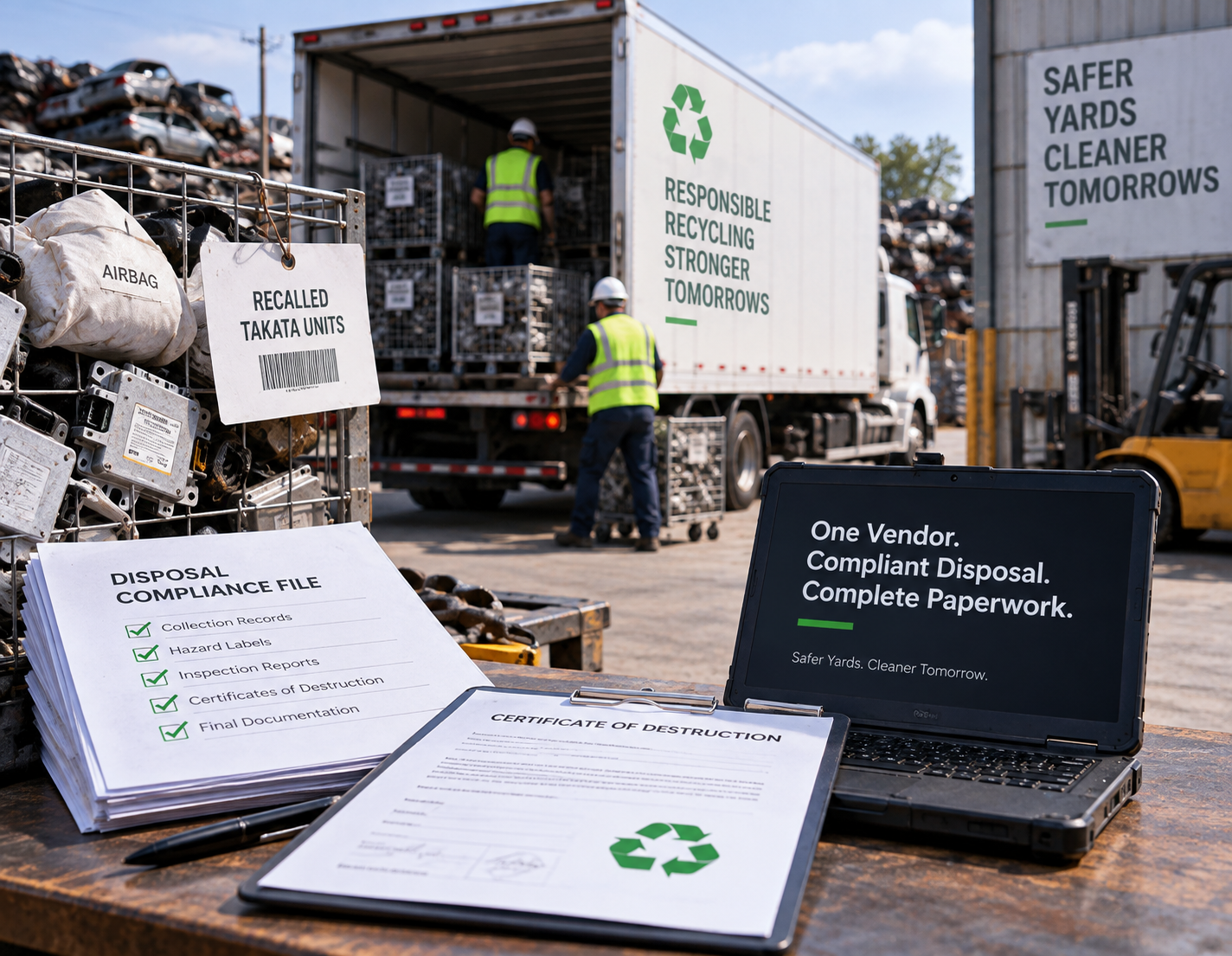
Auto repair shops, dealerships, and salvage yards that generate airbags regularly as part of collision repair or vehicle dismantling typically need an ongoing arrangement with a licensed hazardous waste hauler rather than relying on one-off consumer disposal options.
If your business handles airbags in volume, confirm with a hazardous waste service whether they offer scheduled pickup and what documentation, if any, they provide for compliance purposes.
Frequently Asked Questions
Storing an undeployed airbag is a risk, especially near heat sources. It’s best to arrange disposal rather than storing it long term.
Some salvage yards handle undeployed airbags as part of routine vehicle dismantling, but not all are equipped to do so. Confirm with the specific yard before bringing one in.
It depends on the facility and whether the airbag is deployed or undeployed. Auto shops sometimes handle disposal as part of a repair job at no separate charge, while hazardous waste facilities may charge a fee for undeployed units.
Contact the vehicle manufacturer or an authorised dealer first, since recalled airbags sometimes follow a different disposal or replacement process than a standard undeployed airbag.
This isn’t something to attempt without proper training and equipment, since deployment involves a rapid chemical reaction that can cause injury if handled incorrectly. Leave deployment to a qualified shop or disposal facility.
Ready to Dispose of an Airbag the Right Way?
Search your ZIP code to find airbag disposal near you, confirm whether the facility accepts deployed or undeployed units, and avoid handling a live inflator on your own.
A directory-style guide to airbag disposal near you: where deployed and undeployed units can go, what each type needs, and how to handle one safely before it leaves your hands.